 NanoSense
One platform for the care journey.
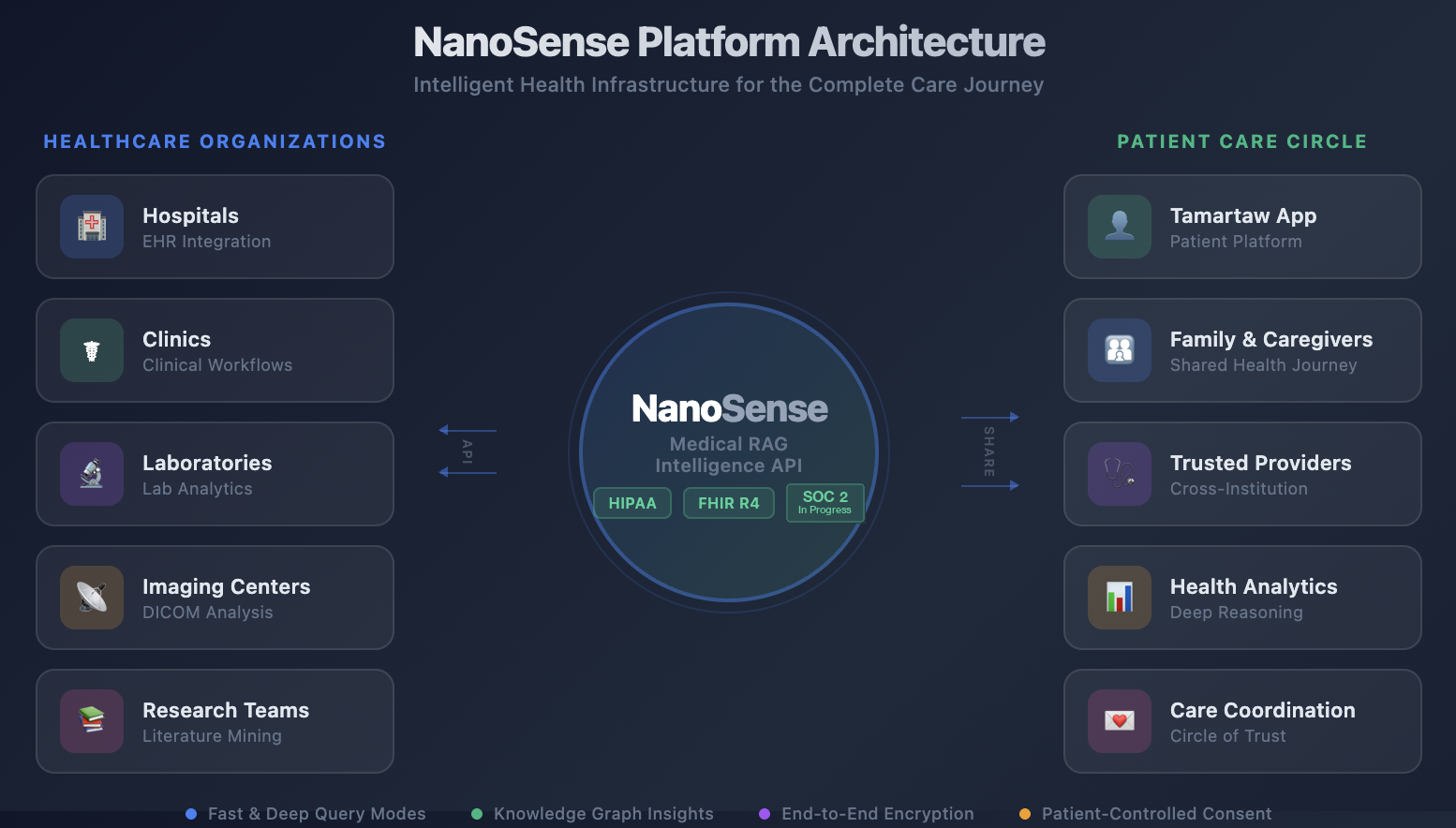
NanoSense connects your healthcare data to a medical RAG intelligence layer. It retrieves, reasons, and grounds every answer in the patient’s own record. It is read-only: nothing is written back, and your EMR stays the system of record.
How it fits together
Healthcare organizations connect on the left. Patients and caregivers receive grounded insights on the right. NanoSense sits in the middle.
Query modes
Pick the depth of reasoning your use case needs. Every mode is grounded in the patient’s record and returns a confidence score.
| Mode | What it does |
|---|---|
| Fast | Few-shot SQL over the EHR with a grounded summary. Suited to high-volume clinical lookups. |
| RAG + CAG | Retrieval-augmented generation with contextual augmentation. Our recommended mode: balanced accuracy with prompt-caching cost savings. |
| Deep Thinking | Multi-step LangGraph reasoning for complex clinical questions that need to weigh several parts of the record before answering. |
| Radiology | Imaging-aware queries that pull in studies and radiology reports when a question is about imaging findings. |
| MCP | Model Context Protocol tools for agentic integrations: query the EHR, search the knowledge base, and reach external sources from an agent. |
Not sure which? Start with RAG + CAG, the best accuracy-to-cost balance for most clinical workflows. See plans
From question to grounded answer
Every query follows the same auditable path, and the order matters.
- AuthenticateA tenant API key or JWT identifies the caller and scopes every result to that tenant’s data.
- RetrieveThe question is turned into a validated query over the patient’s conditions, medications, labs, and history.
- ReasonThe LLM reasons over the retrieved record with PHI redacted, producing an answer grounded in the record.
- ReturnYou get the answer, a confidence score, and the sources used, ready to surface in your app. Nothing is written back.
Knowledge graph
Beyond flat records, NanoSense links conditions, medications, procedures, and observations into a graph. It surfaces relationships a single query does not see.
- Cross-entity insights, such as how a condition relates to a medication in the record
- Visualizations for clinicians and care teams
- Literature mining to connect the record to current evidence
The assistant cites the record and does not replace clinical judgment.
Technology stack
| Layer | Components |
|---|---|
| API | FastAPI, REST, FHIR R4 |
| Reasoning | LangChain, LangGraph |
| Data | PostgreSQL, FAISS, LanceDB |
| Models | Ollama, vLLM, Groq, OpenAI |
| Infrastructure | AWS ECS Fargate, RDS, KMS |
| Compliance | Built for HIPAA, BAA with every customer, SOC 2 Type II in progress |
Access
Subscribe through AWS Marketplace, then bring your data and ask your first question.
References
- Request the security whitepaperSent by email until the PDF is hosted
- Request the Business Associate AgreementSent by email until the PDF is hosted
- Security and data handlingControls, retention, subprocessors and shared responsibility